Buying guide
Aluminium and acrylic, and why it matters here
Most wardrobe marketing talks about materials in adjectives. This page is the actual engineering, including the parts where our materials are the worse choice.
Quick answer: is aluminium better than wood here?
In a Singapore bedroom, aluminium and acrylic outlast wood-based board for one dominant reason: humidity. Particle board and MDF are wood fibre and glue, they absorb atmospheric moisture, and at the 70–80% relative humidity a local bedroom sits at for months they swell — which is why a three-year-old flat-pack wardrobe has doors that no longer line up and shelves with a permanent bow. Aluminium absorbs nothing and does not move. It is also far stiffer per millimetre of section, so the frame can be 38 mm instead of the 80–100 mm a board carcass needs, which is what makes a wardrobe you can see into possible at all. Cast acrylic doors are about half the weight of glass and roughly ten times more impact-resistant, so a transparent door is practical in a bedroom rather than a hazard. The genuine trade-off is that acrylic scratches more easily than glass — it needs a soft cloth and soapy water, never an abrasive.
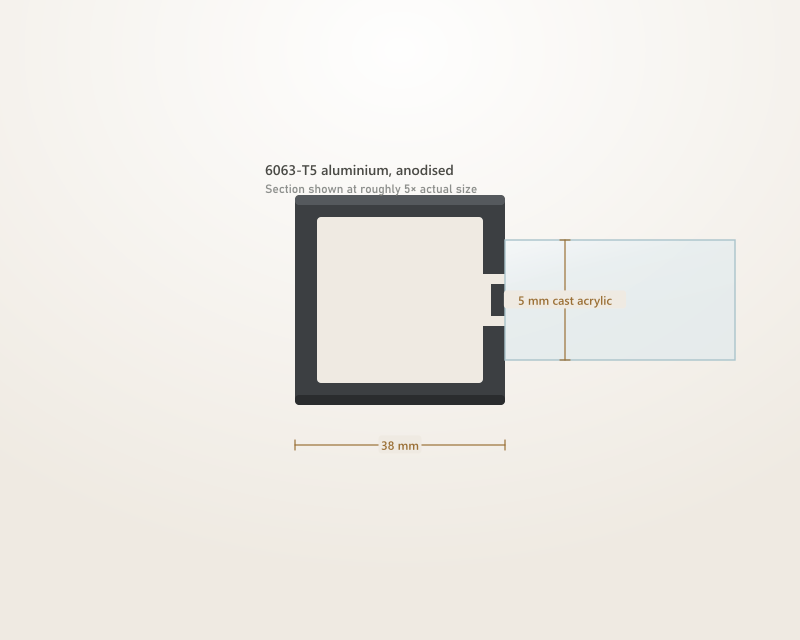
The humidity problem
Singapore sits at 70–85% relative humidity most of the year, and an air-conditioned bedroom that is switched off during the day cycles between that and something much drier every twenty-four hours. Wood-based board hates this. Particle board and MDF are wood fibre bound with resin: they take up atmospheric moisture, swell, and — because the melamine facing is sealed and the cut edges usually are not — swell unevenly. A door that has absorbed moisture along its bottom edge no longer sits square in its opening, and it will not go back.
This is not a defect in cheap furniture; it is the material behaving as the material does. It is also why fitted wardrobes in Singapore are so often quoted in marine plywood or aluminium rather than the chipboard used across most of Europe.
Why the frame can be this slim
A wardrobe carcass in 18 mm particle board needs a lot of material to stay rigid over two metres — which is why board wardrobes have thick visible edges and solid side panels doing structural work. Aluminium is roughly five times stiffer per unit of weight, and an extruded section can put that material exactly where the bending happens.
The result is a 38 mm frame that carries a 2300 mm door with no visible deflection. That number is the whole product: a slim frame is what allows the doors to be most of what you see, and a wardrobe you can see into is not worth building if the frame around it is 90 mm of chipboard.
Cast acrylic, not extruded, and not glass
There are three plausible materials for a transparent door and they are not interchangeable.
- Glass is the hardest and the most scratch-resistant, and it is heavy — roughly double acrylic at the same size. That weight is carried by the hinges, and hinges that carry more go out of adjustment sooner. Tempered glass is safe when it breaks but it does break, into a bedroom floor people walk on barefoot.
- Extruded acrylic is the cheap version: a faint directional haze, more prone to crazing around fixings, and it yellows sooner under UV. It is what most budget acrylic furniture uses.
- Cast acrylic — what we use — is polymerised between glass plates. Optically clearer, far more UV-stable, machines to a real polished edge, and takes a reeded profile cleanly. It costs about double extruded at sheet level.
Polycarbonate comes up often and is the wrong answer for a door: tougher than all three, but it yellows visibly within a few years and scratches more easily than acrylic.
Where our materials are the worse choice
Two cases, honestly. If you want a wardrobe that reads as warm timber furniture, aluminium and acrylic will not get you there — a veneered or solid-wood piece will, and no finish we offer is a substitute. And if the wardrobe will take genuine abuse, a workshop or a much-used family utility room, glass doors resist scuffing better than acrylic and a laminate carcass costs a quarter of what this does.
The case for aluminium and acrylic is a bedroom in a humid climate, where you want to see what you own and you want the doors to still line up in ten years.
The one thing to know about care
Acrylic is softer than glass and it will scuff if you clean it with anything abrasive — a scouring pad, a paper towel with grit in it, a solvent cleaner. Soapy water and a soft cloth is genuinely all it ever needs, and one is supplied with every wardrobe. Light scuffing on clear panels can be polished out with an acrylic polish, which is not true of glass: a scratched glass door is scratched forever. Full care instructions.
Materials questions
Is aluminium better than wood for a wardrobe in Singapore?
In a Singapore bedroom, aluminium and acrylic outlast wood-based board for one dominant reason: humidity. Particle board and MDF are wood fibre and glue, they absorb atmospheric moisture, and at the 70–80% relative humidity a local bedroom sits at for months they swell — which is why a three-year-old flat-pack wardrobe has doors that no longer line up and shelves with a permanent bow. Aluminium absorbs nothing and does not move. It is also far stiffer per millimetre of section, so the frame can be 38 mm instead of the 80–100 mm a board carcass needs, which is what makes a wardrobe you can see into possible at all. Cast acrylic doors are about half the weight of glass and roughly ten times more impact-resistant, so a transparent door is practical in a bedroom rather than a hazard. The genuine trade-off is that acrylic scratches more easily than glass — it needs a soft cloth and soapy water, never an abrasive.
Is acrylic better than glass for a wardrobe door?
For a wardrobe door, yes, on three counts. Cast acrylic is about half the weight of glass at the same size, which is what allows a slim 38 mm frame and lighter hinges that stay adjusted. It is roughly ten times more impact-resistant, and when it does finally fail it cracks rather than shattering into a bedroom floor — which matters in a room people walk through barefoot. And it can be cut, drilled, polished and reeded to shape without tempering, so a fluted or bespoke panel is possible at all. The real trade-off is scratching: glass is harder, and acrylic will scuff if you clean it with anything abrasive. Wipe it with a soft cloth and soapy water and it stays clear for decades; take a scouring pad to it once and it will not.
Will acrylic doors scratch?
They can, and it is the one genuine weakness of the material. Acrylic is softer than glass, so an abrasive cloth, a scouring pad, a solvent cleaner or a ring on a hand wiping the door hard will mark it. Ordinary use will not: soapy water and a microfibre cloth is all a door ever needs, and one is supplied with every wardrobe. Light scuffing on clear panels can also be polished out with an acrylic polish, which is not true of glass — a scratched glass door is scratched forever.
Does frosted acrylic show fingerprints?
Much less than clear, which is a real practical reason to choose it. A satin surface diffuses the oils from a fingertip instead of holding a sharp print, so a frosted door looks clean for far longer between wipes. If your wardrobe is in a room used by children, this alone is worth the decision.
Which finish should I choose if I cannot decide?
Frosted. It costs nothing over clear, it hides fingerprints, it forgives an untidy shelf, and it still lets you find things by colour and shape at a glance — which is the actual daily benefit people buy a see-through wardrobe for. Clear is the more striking object and the one to choose deliberately; frosted is the one nobody regrets.
What does "anodised" actually mean?
Anodising converts the outer layer of the aluminium itself into a hard oxide, electrochemically. It is not a coating sitting on top — there is nothing to chip off, peel or scratch through to a different colour underneath, because the colour is in the converted metal. That is the difference between an anodised frame and a powder-coated one: powder coat is a paint layer, and a hard enough knock will expose the metal beneath. We anodise at 15 micron on the natural finish and 20 micron on the darker ones, because a dark finish shows wear sooner.
Is cast acrylic really different from the cheap stuff?
Yes, and it is the difference that decides whether a door still looks good in ten years. Extruded acrylic is made by pushing molten polymer through a die — it is cheaper, it carries a faint directional haze, it is more prone to stress-crazing around drilled holes, and it yellows sooner under UV. Cast acrylic is polymerised between glass plates: optically clearer, far more UV-stable, machines to a genuinely polished edge, and takes a reeded profile without stress marks. It costs roughly double at sheet level. Polycarbonate, which people often confuse with both, is tougher again but yellows noticeably within a few years and scratches more easily — it is the wrong material for a door you look at every day.
Will an aluminium wardrobe feel cold or industrial?
It depends entirely on the finish, which is why there are five. Natural anodised silver does read technical, and in a room with warm timber it can look like office furniture. Champagne and bone white do not — champagne in particular reads as brass from across the room and is the finish that most changes how expensive the piece looks. If you are worried about this, it is the single best reason to see them in person before ordering.